It wasn't long, when in 1971, they found a new meeting place, a large ground floor room at the Yarmouth Central Library for a few shillings. They met here Friday evenings from 7.30pm and it was a more centralised and well-known building in the town, ideal for meetings and easy for new members to find. About the time they moved to the Central Library two older members joined them in the form of John Seymour and John Skippings. Once settled into the society's routine, they saw a serious need for restructuring. Messrs Seymour and Skippings suggested making changes to the committee and set out some society rules. Membership was low and in need of growth, which the necessary changes were hoped to bring about.
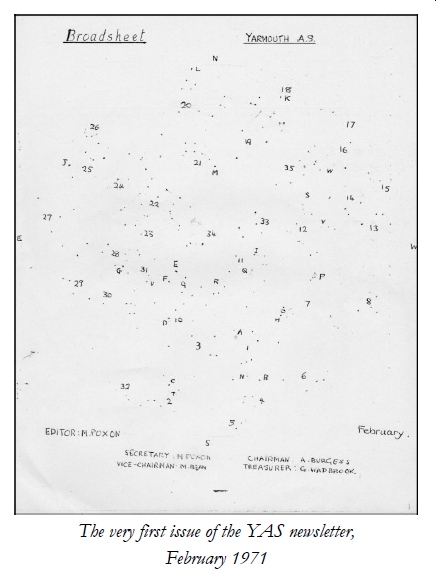 Albireo: Most societies at some point start producing an in-house newsletter for its members. GYAS followed the same path. The first attempt to produce a newsletter was in 1971, called the YAS broadsheet that was based on the design of the Norwich Astronomical Society's broadsheet. A4 size, it had from 6 to 8 pages per issue. Because the young society had no means of printing the broadsheet, Michael Poxon spent hours typing out each separate individual newsletter. Not only did he type each newsletter, he also drew the simple sketches on the cover and all the illustrations within its pages. Most of the articles within the broadsheet were short, concise and very basic, but as the society progressed the contents of each article became longer and more in-depth. For any publication to become successful, and no matter what size or how complex the subject may be, the need for contributed articles, notes and letters etc from members was paramount in order to keep a newsletter alive. Because the contribution of such material was rather sparse, members were constantly encouraged to become more active as many of the society's articles were contributed by the same members time and time again. As a means of encouraging members to contribute to the newsletter, a number of ideas were created such as John Seymour's yearly competition. The idea worked well, but there was no flood of articles. In October 1971 the YAS broadsheet changed its name to Albireo, which was suggested by Michael Poxon who saw the name on an astronomical newsletter from Hungary, as he was corresponding with the Hungarian group at the time. As a result he began to learn Hungarian (not a normal european language) which was useful in gaining an honours degree in linguistics at UEA a few years later!
Making Changes: Restructuring ideas didn't go down too well, and the younger members, some of whom were the founders of the society, saw the more mature members as interfering adults. Despite this, changes were made, which in time placed the society on the road to greater success, and the two Johns became great assets to the society. It was in 1970 that the society became official with a proper committee and a programme of events. By the winter of 1971, a set of rules was finally established and published in the society's Albireo journal. In that year there appears to have been only 7 members, which expanded to 9 in 1972. Even though it had recently set up a new committee, with such a small body of members it had almost no input of articles from its (often rebellious) members. As a result, the society had no choice but to drop its newsletter between 1972 to 1974. Publication at that time became impossible.
However, with continued effort and perseverance from the senior members the small number of dedicated members managed to keep the society alive. Towards the end of the fallow period in the summer of 1974, the society began to see the fruits of its labours. Membership increased to 17 in all, doubling the size of the society. The doubling of membership brought about the revival of its newsletter in October 1974. The following two years saw a healthy, growing interest in astronomy amongst the members, an interest that brought them together as a stronger unit, leading to regular meetings every two weeks. But as always, another challenge was setting in. Their regular meeting place at the library was in jeopardy due to an increase of hiring fees. Extra expense had caused the committee to consider putting up membership fees to cover the extra costs, which might trigger, once again, a downward trend in membership numbers.
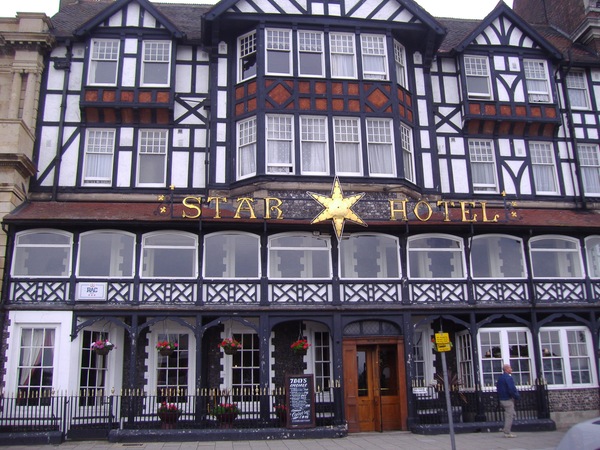 Time to move: A solitary society by itself holds very little clout when complaining about the rising cost of hiring rooms, but it was considered if several societies hiring library rooms for their meetings got together with the same complaint, then perhaps between them they might have greater power to defer the rise of hiring costs. Led by the GYAS, several societies banded together to make complaints against the Yarmouth Library. Despite the banding, their efforts seem to have made very little impact and the fees continued to rise. In the early part of 1980, a new meeting place was found at the famous (and appropriately-named) Star Hotel. They were offered a room for free as long as its members were willing to buy drinks during their meetings, which were held monthly on the last Friday of each month. It was while at the Star Hotel, where, on the 15th May 1981, guest speakers Nigel Henbest and Heather Couper were invited to give a lecture to the society on the subject of deep space, the changes started to be made. Shortly after that momentous meeting, the Yarmouth society decided to move to the town of Lowestoft where the majority of its members were living. Having moved to Lowestoft a new and appropriate name was needed to mark a new historical chapter. With the society now based in Lowestoft, the most appropriate name chosen was the Lowestoft & Yarmouth Regional Astronomers, which coincidently corresponded with the letters of the constellation, LYRA!